Jupiter photo from iPhone's video shoot

Processed image of Jupiter from an iPhone 6 Plus video recording

Lots of planetary photos from amateur astronomers seem to be derived from a small video camera attached to the telescope. I do have lots of smartphones that could serve a similar purpose, so decided to make use of them instead. Holding it steady in front of the eyepiece was a problem, as evidenced by my earlier attempt, so some sort of an adapter was needed.

Attaching iPhone 6 Plus to Celestron telescope with Snapzoom adapter

This is where Snapzoom digiscoping adapter came in. I originally bought this several months ago to photograph stars using binoculars, but it could be made to work with telescopes by attaching an included weight. After lots of paddings here and there, my iPhone 6 Plus was able to fit into the adapter and work with the eyepieces that I owned.

Once my NexStar 6SE telescope was aligned with the stars so that I could track any celestial objects, I slid the phone-adapter-eyepiece assembly into the telescope and began looking at Jupiter and the Moon, the biggest targets.


And this is how Jupiter showed up on the screen. The bands and the Great Red Spot were faintly visible, just as I saw with my naked eyes. The shakiness due to the atmospheric turbulence was also quite apparent. I recorded the sight for two minutes and processed the resulting video through PIPP. Finally, the processed video was stacked and sharpened with RegiStax. The final result, as you saw at the beginning, has a more "natural" feel than the ones from SX50 HS for some reason.

Telescope: Celestron NexStar 6SE + 5mm eyepiece
Device: iPhone 6 Plus (afocal)
Settings: 29mm - 1920x1080 - 30fps - f/2.2
Filters: None
Time: 2015-04-27 21:57-59 KST
Location: Naju, Korea
300 frames stacked with RegiStax 6.1.0.8

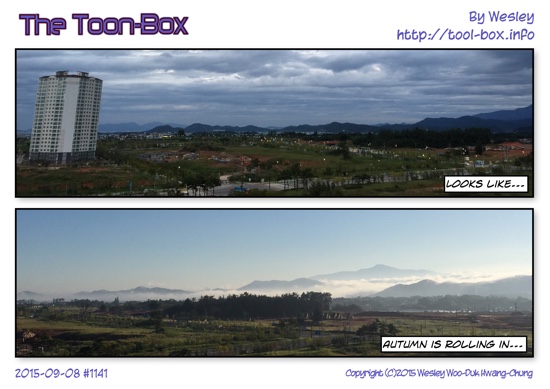
Today's "The Toon-Box"

Defined tags for this entry: , ,

Today's "The Toon-Box"

Defined tags for this entry: , ,

Today's "The Toon-Box"

Defined tags for this entry: ,

ISS transits the Moon

ISS grazes the bottom of the Moon

Solar panels of the ISS become visible against the backdrop of the Moon
Yesterday evening presented a rare opportunity of viewing the sun-lit ISS whizzing by the Moon from where I live. Luckily, the weather cooperated and the sky was mostly clear of clouds. I initially set up a telescope to see it, but the apartment window was too limited for it to calibrate in time, so I fell back to using my SX50 HS's zoom capability instead.

A few minutes before the crossing, the space station started to appear on the western sky. So I told my daughter Celine to come over and see the phenomenon together; we watched it gracefully travel eastward. When I saw that the ISS was about to transit the Moon, I let the burst mode of the camera snap 10 photos in rapid succession at 13fps. Then, we kept watching the ISS until it disappeared into the eastern sky.

Checking the photos, I noticed that the dot the ISS was supposed to be was smaller than what was expected according to CalSky, which predicted the transit. Then I looked at the first photo where the Moon got behind the ISS, which showed a "shadow" much longer than the dot. This is when I realized that the dot was the central area of the space station and the shadow was its solar panels. The size mystery was solved.

For those of you who would like to see a full resolution composite of the ISS-Moon transit, [click here] to load the image. It's a bit sad I can't adjust the ISO setting while shooting in burst mode with the camera - I would've like to have it lowered for less coarse images.

Device: Canon SX50 HS
Settings: 1200mm - ISO 800 - 1/1000s - f/6.5
Filters: None
Time: 2015-04-24 19:56:49 KST
Location: Naju, Korea
Defined tags for this entry: , , , ,

Copyright (C) 1996-2026 Woo-Duk Chung (Wesley Woo-Duk Hwang-Chung). All rights reserved.