Making of the Portable Athlon (2/10)
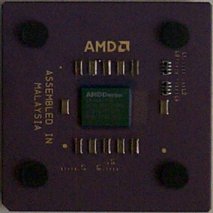
Posted by Wesley onThough in the coming months it may become different, 'Athlon' of today and 'Portable' are some sort of oxymoron. The T-bird Athlon's maximum power dissipation is already around 70W, comparable to an ordinary light bulb. Actual power consumption is higher than that. This is is a bit too much, even for a desktop system, considering high-end CPU's of half a decade ago usually consumed 1/10th of this. T-bird is arguably one of the fastest desktop PC CPU's, but it certainly shows this was done in a very 'brute force' manner. Some 'mobile' Duron notebooks have come out, but we know that it's just our usual Durons that've been underclocked and under-voltaged. Its power consumption is still more than twice that of a competing product. 'Palomino' revision of Athlons, which promise to consume far less energy while delivering more computing power, may change all this, but I couldn't sit around waiting for this chip, and I think it was relevant, considering the release of this CPU has been pushed back already somewhat.
You might be thinking at this point, 'then why don't you just use an Intel CPU, which consumes less power yet performing similar to AMD chips?' This was because my main systems were already using AMD platform, as apparent in my other articles. I needed to buy parts as I made money, using parts from my original system in the mean time. Going straight to Intel platform was not viable. Therefore, I decided to use the Duron as the CPU. They perform nicely and don't consume power as much as T-birds.
On to other things, I planned to use as much normal desktop components as possible to ensure best performance. However, to make the system portable, the casing had to be kept low-profile. One of the biggest thing that hinders this is the card in the expansion slot. Most of these could be replaced with external versions, but video card cannot. So the on-board video had to be considered. But this thought was thrown out almost immediately; I'd rather buy a notebook with Rage Mobility video chip than on-board video, and motherboards with on-board video for AMD platform was nearly non-existent in Korea at the time. The video card had to be kept in somehow, just as I chose a Duron for CPU despite the power consumption. Besides, if I wanted a unit with on-board video, there are already some low-profile systems, even a bare-bone one that I can equip with components of my choice, that utilize this sort of motherboards inside. I would have no point in making this. I had to find a video card that isn't so tall.
Another thing that had me rolling in my bed for another day was the hard disk. The big question was wheter I should use a 2.5" notebook hard disk or a normal 3.5" hard disk. This had to be thought of carefully because a 3.5" hard disk is about 1/4 of the size of a normal motherboard. You might think this isn't so large, but considering the fact that I have to cramp it in somewhere that won't interfere with a power supply, a CPU, or a video card meant that it would be a real tough job. Since you can fit 4 of those 2.5" hard disks into an area that a 3.5" counterpart takes up, it seemed to be a better solution. But there are obvious setbacks: they are expensive, slow, and small in capacity. I also needed a converter so I could plug it with a normal IDE cable. I decided that I would think of this one as I go along because a slight design change would make all the difference.
Don't be bored yet, guys. There are still more to come...