μ’‹μ•„, μ˜€λŠ˜μ€ μ Έμ€€λ‹€

λ­μ‹œλΌ? λΈ”λ‘œκ·Έ? μ™œ 이런 κ±Έ λ‚΄κ°€ 써야 ν•˜μ§€?
μ–΄μ°¨ν”Ό μ’€ 있으면 흔적도 없이 μ‚¬λΌμ§ˆ 것을...

근데 λˆ„κ΅°κ°€ 계속 닀녀가더ꡰ. μ•„λ¬΄λž˜λ„ ν…… 빈 κ³΅κ°„λ§Œ μžˆμ–΄μ„œλŠ” μ•ˆλ  것 κ°™λ‹€.
자, 읽을 거리 μ£Όμ—ˆμ§€? 그래, μ˜€λŠ˜μ€ μ Έμ€€λ‹€, 넀이버. 이 λ‚˜μœ λ†ˆμ•„.

From "Wesley's Filling Up of Empty Space" at Naver Blog - August 2005
Blowing Some Dust Off

I'm doing/done extensive HTML-level fixes and optimizations on all of the web pages here which won't be very obvious to the casual visitors but will greatly simplify the way I maintain this website. Currently, the main pages have been updated but the actual articles are not affected yet. I also need to specify the URL redirection changes to the host.

Heatpipe Madness

Heat problems have plagued the XPPort-II (a.k.a. Portable Athlon II) due to the high-performance components that make up the system, while having too cramped a space to have sufficient cooling applied. The solution was to use heatpipes to move the heat to where it can be properly cooled. Read on to find out how this helped stability and overclocking.

The Heatpipe Mod on XPPort-II (11/11)


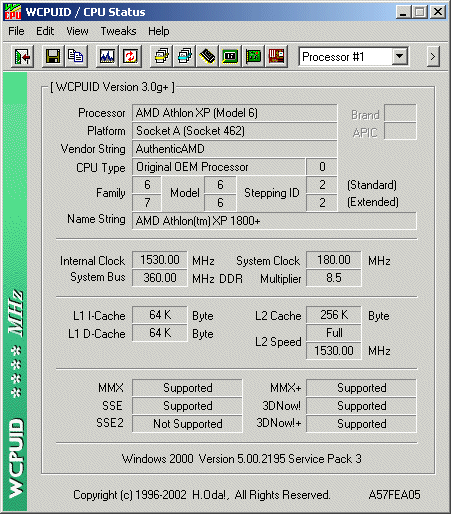
WCPUID analysis

Recently, I managed to buy a Samsung PC2700 512MB DDR-SDRAM (CTL version) that would replace the two KingMax 256MB memory modules. The KingMax failed to make past 170.8MHz even with voltage at 3.2V, and I considered it to be one of the hindrance factor. Now with the Samsung module, I could hit 180.0MHz at fastest memory timings at 3.0V.

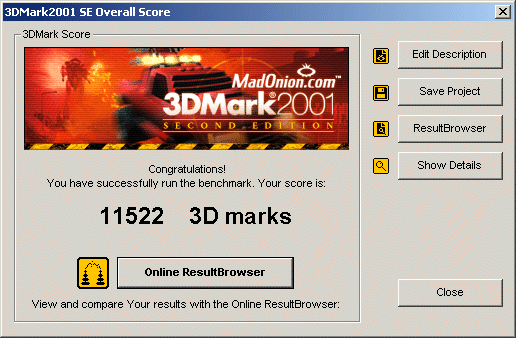
To gauge the performance gained, I used MadOnion's 3DMark 2001SE. The following scores were posted without overclocking the video card:

170.8MHz FSB: 10035
180.0MHz FSB: 10447


The FSB increase alone accounted for approximately 400 points of increase. Keeping this in mind, the following scores are the best results obtained under the configuration before and after the mod, while having the same video card driver:

Old Best: 10800
New Best: 11522


3DMark score

Even considering the FSB boost, the new best score beats the old score by at least 300 points, having an overall increase of 700 points. This is sufficient enough to put my system within top five machines configured with AthlonXP 1.55GHz or less and with GeForce4 Ti4200. Considering that most of the high-scoring machines used the Detonator 40.41 driver, which puts out around 300 to 1000 points more than the 29.42 driver I used, I might be able to rank at the top once I get this driver working properly. :-) Note that this score is currently the highest possible score while having the system completely stable. I might be able to squeeze a few more points while compromising stability just to the point that 3DMark barely completes, but that goes against my philosophy...
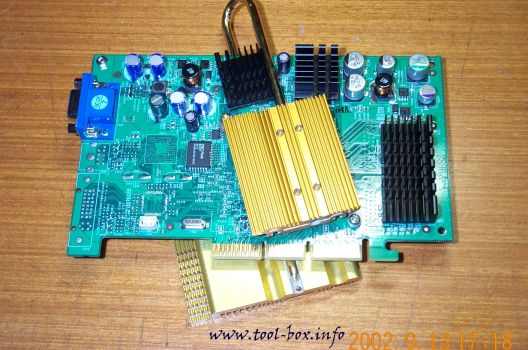
To conclude, the installation of the heatpipes in the system increased the stability of the overall components while boosting enough headroom to overclock even further to get new performance limits thanks to the lowered temperature provided through efficient cooling. It was something that a cramped up system like mine with limited airflow had just needed.

The Heatpipe Mod on XPPort-II (10/11)


Ramsinks installed on the front side

And the front side gets its share of the ramsinks. One of the ramsinks are slanted here, too, but to avoid the heatpipe next to it this time. Overall, most of the ramsinks get a good coverage of the chips despite the obstacles.

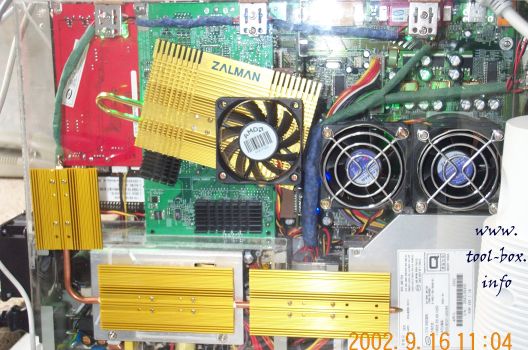
Finalized look of the heatpiped system

Finally, all heatsinks and heatpipes are installed into the system. The PSU heatpipe system spreads the heat away from the video card, while the video card's heatpipe system cools the GPU with an active AMD-logo'ed fan. Ramsinks support texture memory overclocking. It looks pretty spiffy, but ultimately, the verdict lies in how far I can push it.

Copyright (C) 1996-2026 Woo-Duk Chung (Wesley Woo-Duk Hwang-Chung). All rights reserved.