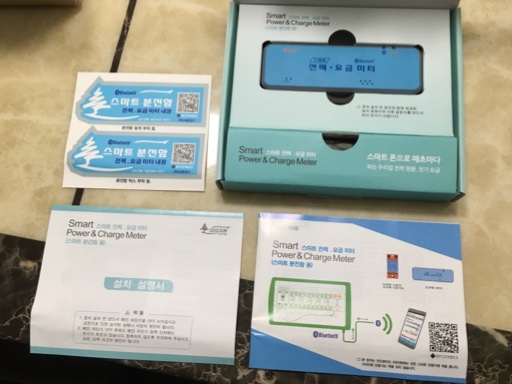
Contents of the Seojun Smart Power & Charge Meter package: stickers, smart meter, installation guide, and user manual
My home isn't particularly wasteful when it comes to electricity spending - it rarely exceeds 200kWh per month except for hot summer months. Still, I wanted to see the real-time usage to make further optimizations. After browsing through myriads of metering solutions, both domestic and abroad, I settled on a particular product sold by Seojun Electric.
Officially called "Smart Power & Charge Meter" model SJPM-B70 (I'll simply refer to it as "smart meter" hereafter), it connects to the main power line going through the primary circuit breaker inside the house. Once installed, it constantly measures and stores the power consumption data. This can then be accessed in real time by a smartphone via Bluetooth technology.
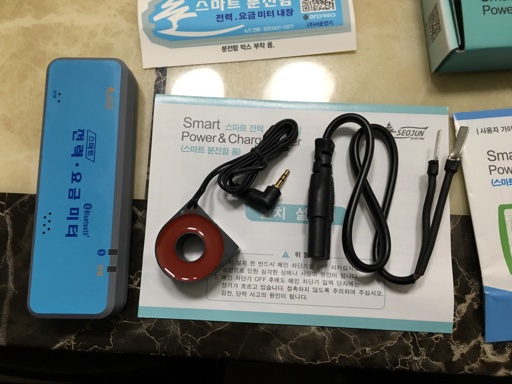
Current sensor and the power plug for the meter
The main thing going for this product is its cost and simplicity. It only costs KRW 42,000 (US$35) online, not much more than the power monitors you plug into an outlet. And you merely need to hook the sensor and the power plug into the right place to get it working - no further maintenance required. Instructions on how to do that are shown with diagrams in the included guide.
You also don't need to sign up for anything as the data stays in your house, fully under your control. As I don't need to have my consumption data shared and analyzed over the internet cloud, this was actually a plus for me. And in case you wanted to show that you have this smart meter installed, the package provides two blue stickers to let you do just that.