Server updated to Mavericks!

Screenshot of installing OS X Mavericks downloaded from Mac App Store
Installing OS X Mavericks downloaded from Mac App Store
I've been wary of installing new OS upgrades on the server because it can easily mess up the custom configuration I set up. In fact, that was primarily the reason why my old iMac that ran my websites (including this one) until early this year ran Snow Leopard (OS X 10.6) for 3 and a half years until it broke down. I passed upgrading to Lion (10.7) or Mountain Lion (10.8 ) all that time. I ultimately moved to Mountain Lion only because the new Mac mini that replaced the iMac required it.

This time was different. I had simplified the server configuration and kept track of the modifications. Basically, it was down to a couple of configuration files for built-in Apache server, and a separate MySQL installation. Downloading Mavericks (10.9) from the Mac App Store was what took most of the time. It was released as a free upgrade from anything that ran Snow Leopard and up, so there was a huge demand. Once the download was complete, I ran the installer, and it took about half an hour to complete.

Screenshot of iWork upgraded for free on Mavericks
Free iWork upgrades!
I noticed that the websites were broken after the installation, as expected. However, checking the changes revealed that I only needed to fix the main Apache server configuration file. A couple of minutes of fiddling with the file later, the websites came back working properly. This was easily the fastest and the most trouble-free transition to the new major OS X version ever.

As a bonus, Apple had decided to make iWork upgrades to the just-released latest version for free, regardless of whether it was bought on DVD or on Mac App Store. My old copy of iWork '09 installed from the disc got properly upgraded, and the apps now show up in purchases list. Free OS and office suite upgrade, and smooth server transition. Apple has spoiled me.
Defined tags for this entry: , , ,

Today's Jupiter photo

Jupiter and Galilean moons taken with Canon SX50 HS
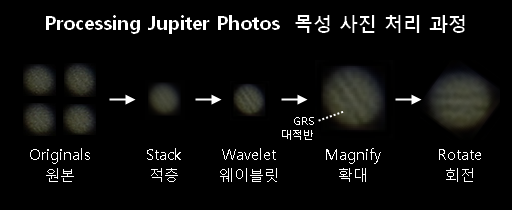
Composites of Jupiter and Galilean moons
Jupiter: 1200mm - ISO 80 - 1/60s - 39 stacked
Satellites: 1200mm - ISO 1250 - 1/10s - 34 stacked
Time/Location: 2013-10-23 00:40 KST / Suwon, Korea

While waiting for Apple to announce new products (the event took place on 2AM in Korea Standard Time) for 2013 holiday season, I tried another shot at taking photos of Jupiter with SX50 HS while its Great Red Spot was facing Earth. It's still not very discernible even after post-processing, but I think the wrinkle at the right-hand edge is likely to be it.

Incidentally, Io and Europa were visually close together, but the camera was able to distinguish between the two. Maybe I should try to take the photos while Jupiter is higher up in the sky - it should have less atmospheric disturbance. You can see the stacked photos of the planet and the satellites before composition if you keep reading.
Continue reading "Today's Jupiter photo"

iPhone 5S accelerometer patched

iPhone 5S (front) now reports same horizontal tilt as 5 (middle) and 4S (back)

Apple had a big product release day just a few hours ago, with new OS X, iPads, and Macs coming out. While it was left out of the announcement, iOS 7 also had a new point release just after the presentation at Cupertino ended. iOS 7.0.3 lists a lot of changes and fixes, and among them is a mention that the accelerometer calibration was fixed. I personally checked on this issue earlier. What better way to verify the fix than actually seeing it for myself?

As you can see, the problematic horizontal tilt measurement of iPhone 5S is now in agreement with the other iPhones. I can also hold the device up and see that it's reporting fairly accurately. Same can be said for the other measurements, which you can see if you decide to keep reading below.

It seems Apple didn't make an independent patch for this problem and instead lumped it together with other fixes since it wasn't a critical one. At least it came out just a month after the first release and before the release in Korea, so I'm glad the Korean users wouldn't have to be concerned from the get-go.
Continue reading "iPhone 5S accelerometer patched"

Recording passage of ISS on video


Cropped photos of the ISS
International Space Station was to make a pass over the early evening sky. I wasn't quite sure if it would be visible because the Sun just set over the horizon and the sky was still relatively bright.

My worries were unfounded when I noticed a bright dot streaking from the southeastern side of the sky - it was nearly -4 in apparent magnitude. I had just enough time to capture it passing below the Moon and then moving into the west. The movement was very similar to my previous ISS sightings, and the close-up photos made me sure it wasn't some airplane making a coincidental pass. It was quite a fun experience overall.
Defined tags for this entry: , , , ,

On the accuracy of iPhone 5S sensors

Compass readings from iPhone 5S/5/4S/3GS
Compass readings from iPhones
5S: 4° / 5: 4° / 4S: 0° / 3GS: 351°

There has been some talk about the sensor (accelerometer, gyroscope, and compass) readings of iPhone 5S being inaccurate, and since those are handled by M7, some are blaming the chip for the problem. I can't verify this claim, but I have multiple iPhones, so I can tell you if iPhone 5S strays far from the norm.

First of all, the compass seems to be doing fine. As you can see here, 5S is getting the same reading as 5, and not far from 4S's. As I moved these devices around, the readings from 4S, 5, and 5S were basically within 5 degrees of each other. 3GS was the actual standout, giving noticeably different readings from the rest of the devices. This could be due to the device's old age.

I should note that putting two phones close to each other, as some people have done to show the differences, is not a good idea. The phones affect each other's magnetic readings from the electromagnetic noise that they generate, making both units' compass deviate. It's akin to putting a magnet next to a real compass. This is why I gave the phones a bit of room. I would disregard any reports of compass error that show the photos of phones being right next to each other.

But what about the measurement of tilt as detected by gyroscopes and accelerometers? Let's take a look at those, too.
Continue reading "On the accuracy of iPhone 5S sensors"

Copyright (C) 1996-2026 Woo-Duk Chung (Wesley Woo-Duk Hwang-Chung). All rights reserved.