On iPhone 5S colour and 5C

iPhone 5S "Blue" and Gold

It's now been nearly two months since iPhone 5S and 5C debuted. They have been available to Koreans for nearly a month as well. So now it's not so hard to find them and take a look if you wanted to. Even half of the people in my team who had old iPhones already switched over to 5S.

If you remember, I gave up the much-sought but hard-to-get gold coloured iPhone 5S for the widely available space gray version because that would've been the only way I could get my hands on a 5S as soon as possible.

Looking back, I think I made the right choice. I was able to test it out earlier than most of the people. And I was going to put a skin on it as a basic protection anyway. This brushed metal style dark blue skin I put on really suits the phone well. When I finally got to see the gold version in person as you can see here, I still felt that my skinned iPhone looked better.

iPhone 5C Yellow and iPhone 5S White

As for iPhone 5C, it did indeed look like someone put a coloured plastic case on a black iPhone 5. Nothing too impressive, really. I would have preferred the look of a 5th generation iPod Touch. I can definitely see how people would rather pay $100 more and get a 5S instead. This is perhaps why there are so many iPhone 5C ads in the city as well as commercials on TV.
Defined tags for this entry: ,

InoQ Tyrannosaurus assembly kit

InoQ Tyrannosaurus moving 3D kit box
Palmtop Tyrannosaurus

There hasn't been much of wind-up toys in the house that my kids could get their hands on. I wanted to fill this hole a bit, but past experiences told me that kids don't play with one toy too long, so I should save money and go for some variety. For this, this little assembly kit series called "InoQ" from David Toy seemed to be a good idea.

I bought a Tyrannosaurus model from a local discount warehouse, which cost about US$3. It was on the low-end of assembly kits as far as price goes, but it said it would move, so it looked better than the stuff that you build and doesn't do anything else after. It also didn't look very sturdy, but considering the price, I thought it should be good enough for several minutes of enjoyment.

And boy, did it give us enjoyment.
Continue reading "InoQ Tyrannosaurus assembly kit"

ISS passing near Jupiter

ISS and Jupiter shot by Canon SX50 HS in a single frame
ISS passes near Jupiter

Yesterday's passing of International Space Station had another interesting characteristic. It came within about 0.65 arc degrees of Jupiter at the closest, and I ended up taking both objects at once in several frames. This crop, reduced to 30%, shows one of such instances. You can see that the station looked both larger and brighter than Jupiter.

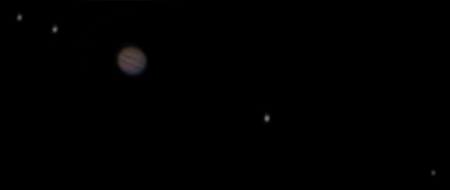
Composite of Jupiter and its satellites photographed by Canon SX50 HS
Jovian system
Callisto - Europa - Ganymede - Jupiter - Io

As for Jupiter itself, I photographed its system slightly later. Ganymede was pulling out of Jupiter and was barely visible outside of Jupiter's bright disc.

Time: 2013-11-12 06:02 - 06:23 KST
Top: 1200mm (reduced to 30%) - ISO 80 - 1/640s - 06:02
Bottom: 1200mm, stacked using RegiStax 6.1.0.8
- Jupiter: ISO 80 - 1/320s - 06:20, 7 frames
- Satellites: ISO 800 - 1/10s - 06:23, 27 frames
Location: Suwon, Korea
Defined tags for this entry: , , , , ,

ISS overhead approach

Three processed photographs of ISS taken with Canon SX50 HS
ISS gets bigger as it rises overhead

Just a day after successful testing of the iPhone-based tracker, ISS made a nearly direct overhead approach in the sky as seen from my house. This would provide an excellent opportunity to take biggest shots of the station because it would be at the shortest distance from the observer when it's directly overhead.

44-frame animation of the International Space Station coming closer
ISS incoming
As the space station rose in the southwestern sky at 6AM, I began tracking it with iPhone 5S and taking shots with SX50 HS. More than 200 shots were taken, and 44 photos deemed of good quality were selected for processing. You can see the animated version of the approach here, as well as the stacked version that bring out the detail of the station at three points of the observation.

This is the first time I could properly see the full spread of ISS in my photos - the solar panels and the main modules of the station in the iconic H shape configuration are clear and large, especially when it was only about 500km away. I'm frankly amazed that a point-and-shoot bridge camera could photograph a satellite this well even under ideal circumstances. We live in amazing times.

Settings: 1200mm (2x enlarged) - ISO 80 - 1/640s
Photos: 13 frames / 9 frames / 8 frames stacked using RegiStax 6.1.0.8
Time: 2013-11-12 06:00 - 06:02 KST
Location: Suwon, Korea
Defined tags for this entry: , , , ,

Tracking ISS successful

International Space Station and Soyuz craft carrying Olympic torch 41-frame animation of the ISS tracked by Canon SX50 HS
International Space Station and Soyuz craft carrying Olympic torch

"Phone-Camera" Reimagined
Earlier this month, I devised a way of photographing the fast-moving International Space Station (ISS) with Canon SX50 HS by tracking the station with iPhone 5S. The phone is mounted on top of the camera using a combination of smartphone tripod mount and hot shoe tripod adaptor. In essence, the phone would serve as a more or less "live wide view" unit, while the camera would keep shooting.

I had a good opportunity to test this setup earlier today, as the space station made its pass from the western sky in the early morning. I aligned the iPhone's screen with SX50 HS's by targeting a faraway object, both at maximum zoom. And then I waited for the station to make an appearance. As soon as I was able to spot it on the phone's screen, I started shooting with the camera.

In the end, I was able to shoot 41 consecutive photos of the station in the span of 18 seconds. This proved that the setup worked beautifully - the only limitation was the tripod not being able to position the camera higher than 70 degrees. Stacked image shows the solar panels of the station, as well as the docked Soyuz spacecraft that carried up the Olympic torch for Sochi 2014 games last week.

Settings: 1200mm - ISO 80 - 1/640s
Time: 2013-11-11 06:50:32 - 06:50:50 KST
Location: Suwon, Korea
Photo: Top photo made by stacking bottom 14 photos using RegiStax 6.1.0.8
Animation: Continuous loop of the 41 photos shot
Defined tags for this entry: , , , ,

Copyright (C) 1996-2026 Woo-Duk Chung (Wesley Woo-Duk Hwang-Chung). All rights reserved.