Longer numeric passcode on iOS

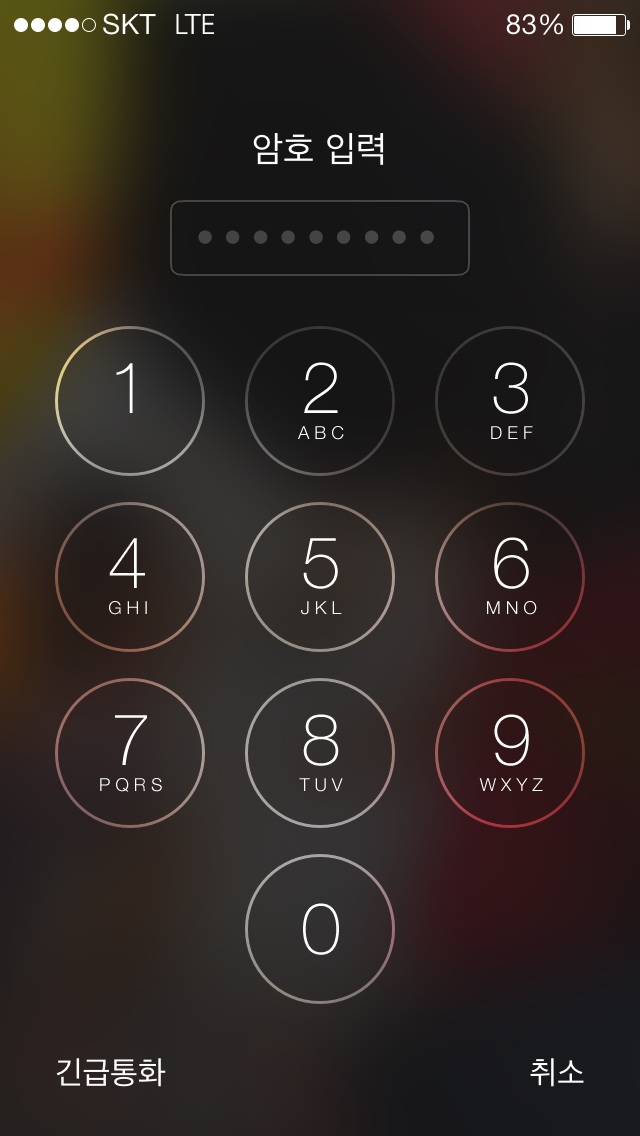
iPhone lockscreen with long numeric passcode
My lockscreen passcode is longer than 4 digits
By default, iOS devices like iPhones and iPads use 4-digit passcodes for the lockscreen. You could also use alphanumeric passcodes that are more secure, but they bring up a keyboard on the lockscreen. This is rather cumbersome compared to a keypad.

What's often overlooked is that there is in fact a nice compromise between the two. You could use a long numeric passcode, and it'll give you a keypad just like when you use a 4-digit passcode, as you can see here. You do need to press a button after entering the digits, but that's because it won't let someone guess how long it is.

I think this is even more useful when coupled with the Touch ID in iPhone 5S. You can still use the fingerprint to conveniently unlock most of the time, and you'll feel more safe in that there is less of a chance someone else could bypass that and unlock using a passcode instead. And the "autofill" of the passcode when you press your finger to unlock doesn't reflect how long the passcode is, either. It just shows nine dots all the time. A perpetrator won't be able to guess the length of the passcode by glancing at your screen.
Defined tags for this entry: , ,

Scored an NFC tag at an expo

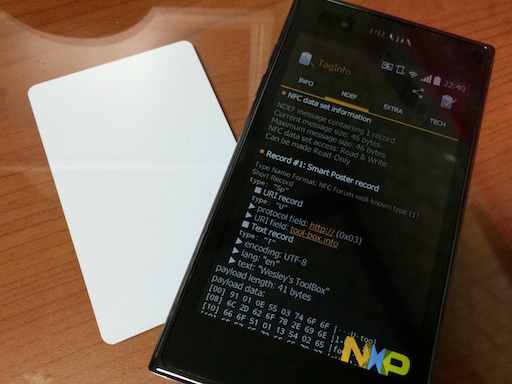
Blank RFID card formatted to work as a tag

Late last month, there was an RFID-themed expo called RFID/IoT World Congress 2013 in COEX. The entry badge happened to contain an RFID card that you could use to tag at a booth so the company running it could know that you visited. It turns out that the card is basically a blank RFID card. My contact info must have been paired to the card's serial number, and the terminals merely checked the number and pulled the paired contact data from a central database.

When I took it home and poked it around with the only NFC-enabled smartphone I have, LG Prada 3.0, the card was a generic MIFARE Ultralight card without any locks or data. These types of card can only contain 64 bytes of data, 48 of which is user-programmable, so it's apparently very limited and cheap. That seems to be a sensible choice for something to hand out to thousands of visitors.

Because it was initially unformatted, regular NFC apps on the phone refused to do anything with it. But with the NXP TagWriter app, I was able to format and write data into it at once. To test, I tried to program the URL of this website and its title into it. It ended up being 47 bytes total, and the card reserved 2 bytes for something else, so it went over the storage limit. I omitted the hyphen and I was able to write the data successfully. When I tag the phone with it, it would load this website.

Looks like I should try to find some cheap MIFARE Ultralight cards like this one and happily program all sorts of things to it.
Defined tags for this entry: , , ,

Copyright (C) 1996-2025 Woo-Duk Chung (Wesley Woo-Duk Hwang-Chung). All rights reserved.