Orion Nebula revisited

Earlier this year, I took photographs of the Orion Nebula, a.k.a. Messier 42, with the Canon SX50 HS camera or with Tamron 18-270mm lens attached to the Canon 450D. This was before I got my Celestron telescope, so I had high hopes of getting even better photos once the telescope was in my hands. Alas, the Orion constellation was already hiding below the horizon before midnight at this point, so I was focused in planetary targets most of the time.

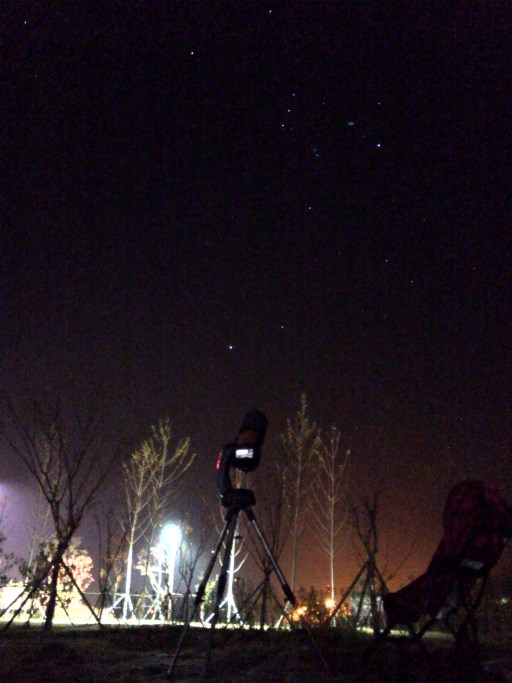
Celestron 6SE and Sony A5000 pointed to the Orion constellation

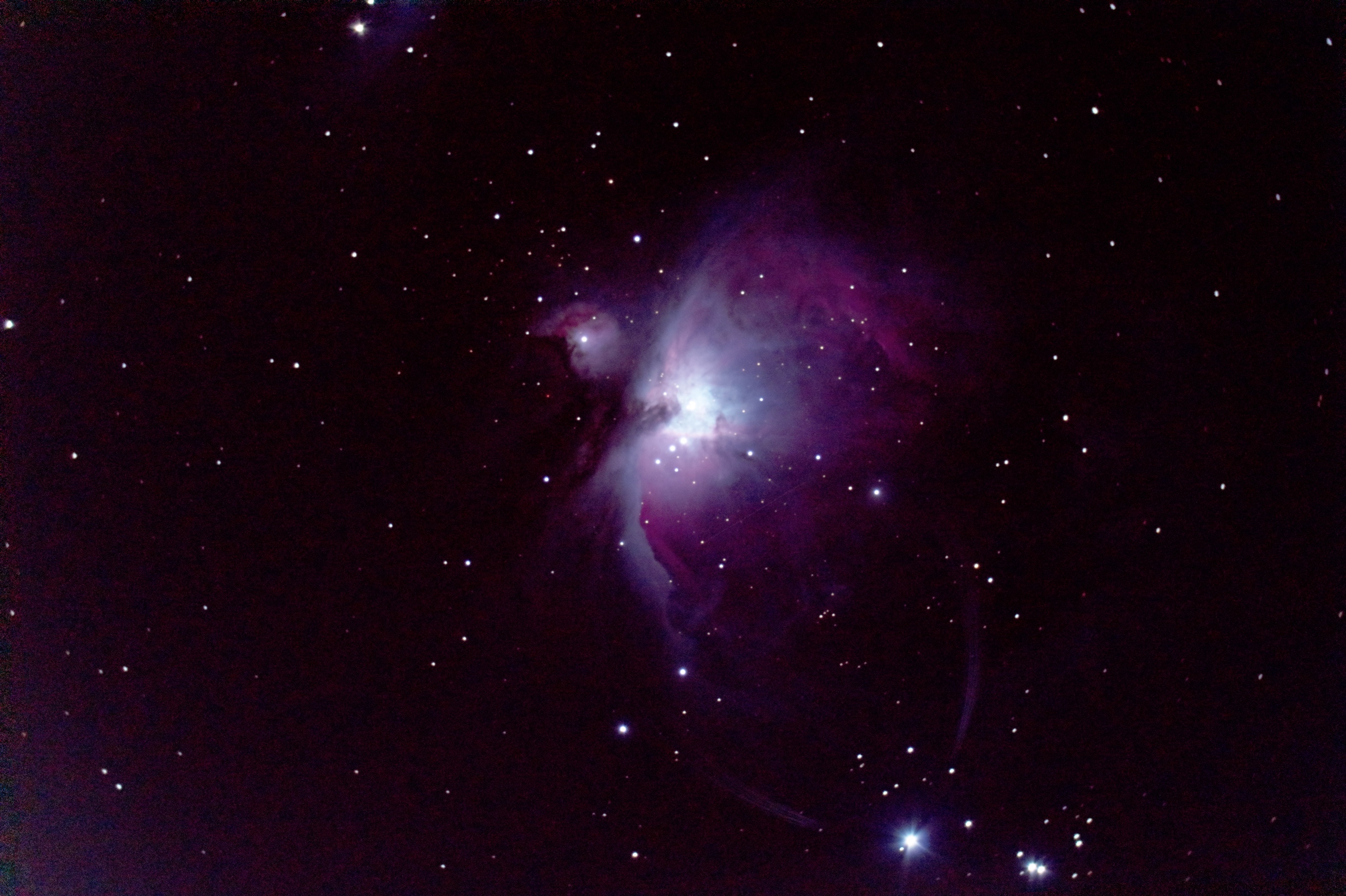
As winter times creeped up again, the constellation was again viewable in the late night to early morning. That is, if the clouds, rain, or fog weren't obscuring it. This happened in the early hours of November 12, so I brought my telescope outside for a couple of hours of astrophotography. While I snapped several targets, the Orion Nebula looked the most promising.

The beautiful Orion Nebula spotted in the southeastern sky (25% size)

As the conditions were good, I took the photos mostly without any filters. Then I took a few with the Baader Moon & Skyglow filter on to see what difference it might make. Once I started post-processing, I could see that the one with the filter might have a slight advantage in bringing out the faint details, but nothing dramatic. With the individual frames ready, I used the Deep Sky Stacker for the first time for automatic selection and stacking.

After about an hour of processing, the software selected five frames from non-filtered ones and one from the filtered ones to deliver this beautiful result. If you click on the photo for a wider, larger view, you can spot a part of the reflection nebula NGC1977 at the top left as well. In the future I may try to get this properly into the frame.

Telescope: Celestron NexStar 6SE + f/6.3 focal reducer
Device: Sony A5000 (prime focus)
Settings: (945mm) - ISO 1250 - 30s - (f/6.3)
Filters: None (5 photos) + Baader M&S (1 photo)
Time: 2015-11-12 00:51-01:14 KST
Location: Naju, Korea
6 photos stacked with Deep Sky Stacker 3.3.4

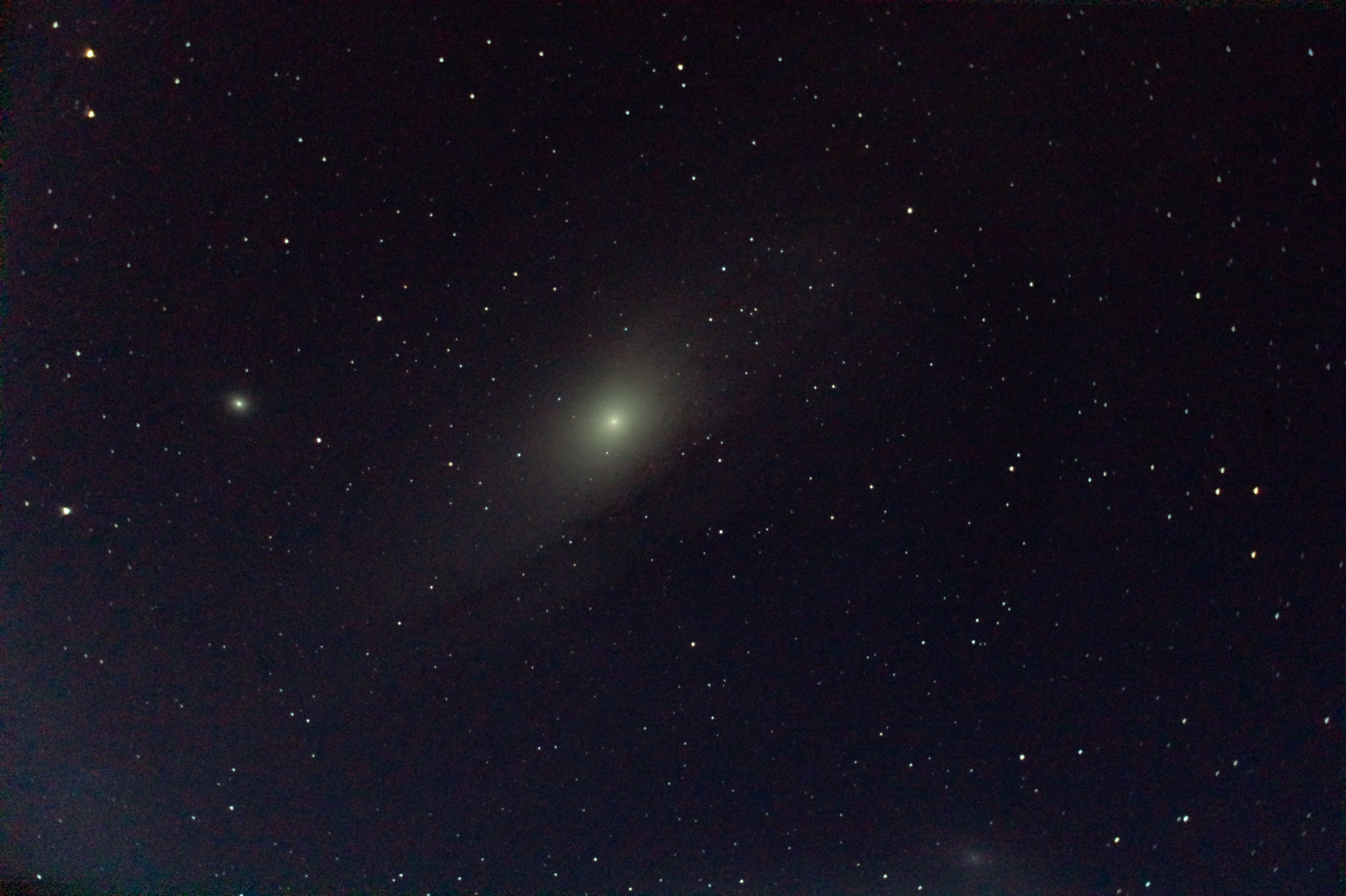
Andromeda Galaxy through the fog

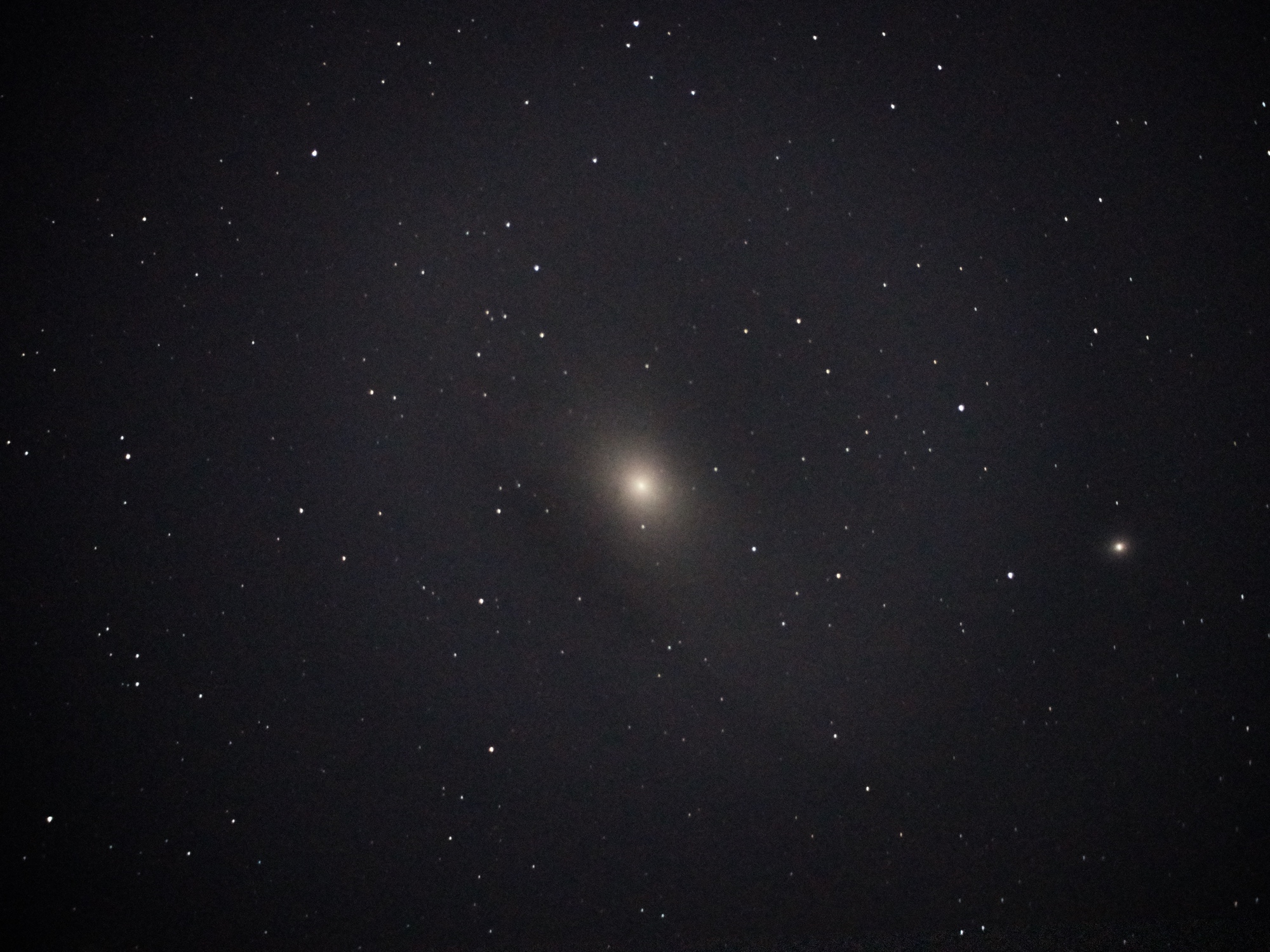
Andromeda Galaxy in the middle and Messier 32 at the bottom (17% size)

With the recent purchase of Celestron f/6.3 focal reducer (as mentioned in The Toon-Box) and the fine-tuning of the secondary mirror collimation, I've been quite eager to do some deep sky photography. Alas, the autumn sky at Naju has not been very cooperative.

For some reason, the days without clouds experienced thick fogs (and possibly smogs) and the days without fogs experienced cloudy sky. As the former at least provided some visibility near the zenith and because the constellation of Andromeda is currently very high up in the evening, the Andromeda Galaxy became the obvious target when the opportunity came.

The best three photos from the shooting session were manually stacked and processed, resulting in what you see above. It seems that the fog blocked much of the structural details of the galaxy, but you can still see a bit of it near the core. Also, the satellite galaxy known as Messier 32 (M32) are clearly visible in the bottom as well. I'll be trying on the Moon & Skyglow filter under a better weather condition to see if I can improve upon this.

(Note: M32 was misidentified as M110 earlier, and has now been corrected)

Telescope: Celestron NexStar 6SE + f/6.3 focal reducer
Device: Sony A5000 (prime focus)
Settings: (945mm) - ISO 1000 - 30s - (f/6.3)
Filters: None
Time: 2015-11-03 20:25-20:45 KST
Location: Naju, Korea
3 photos stacked

DIY artificial star for SCT collimation

Using a Schmidt-Cassegrain telescope (SCT) like my Celestron NexStar 6SE requires the secondary mirror to be collimated properly to get a crisp image. I've done the collimation after fixing the screws, but I wanted to fine-tune further. The adjustment I will be making won't be the definitive for all the cases because the gravity affects the secondary mirror subtly with differing angles. But because the diameter (and consequently, weight) of the mirror is relatively small the deviation after the fine adjustment was hoped to be small.

Ready to modify the LED flashlight

Unfortunately, the real stars often look too shaky, so I decided to try the artificial star method for this tuning instead. An artificial star is basically a bright light source coming from a tiny hole. For the light source, I do indeed have one - an LED flashlight that I bought many years ago. It's actually an external battery for charging phones with a bright LED as a bonus feature, but it's so old that the charging port is a Korean 24-pin standard that was popular about a decade prior. Now it was time for this little gadget to be useful again.

Punching a hole with a pin

I initially tried it out as is, but the LED part was too big. It was time for a little modification. After trying out different materials, I found that a sheet of back cover for making presentation handouts was effective at blocking light, yet did not require complicated tools to work with. A pair of scissors let me cut one up to make a cover over the flashlight. Next, I punched a tiny hole where the LED was supposed to be at.
Continue reading "DIY artificial star for SCT collimation"

Saturn in the early evening with A5000

Saturn as seen by Sony A5000

In the early evening these days, Saturn is seen shining brightly in the southwestern sky. The apartments nearby hinder the sight well before it sets into the western horizon, though. And in a few weeks, even this narrow opportunity would go away. This meant that now was the time to take photos of Saturn with my new A5000.

Preliminary attempts last week were disappointing, however. The planet looked dark and fuzzy. After analyzing the problem, I concluded that the rails on the window and the pollution (atmospheric and light-induced) near the horizon were causing this. So I raised the telescope up a bit and tried to shoot as early in the evening as possible.

As a result, the photographs from last evening came out looking good. Cassini division and the differently-coloured layers of the surface are all visible. This is comparable to the ones I took back in May, even though the apparent size is smaller (18.32 vs. 15.85 arc seconds). This may have been helped by A5000 having a slightly higher resolving power (0.19 vs. 0.20 arc seconds / pixel) than iPhone 6 Plus.

This is encouraging in a couple of ways. This confirmed A5000's ability to provide almost all my astrophotography needs. And on May 2016, Mars will be about as big as Saturn today (excluding the ring part), so I may be able to get some nice photos of the red planet.

Telescope: Celestron NexStar 6SE + 2.5x barlow
Device: Sony A5000 (prime focus)
Settings: (3750mm) - ISO 800 - 1/4s - (f/25)
Filters: None
Time: 2015-09-22 19:35 - 19:44 KST
Location: Naju, Korea
33 photos stacked with RegiStax 6.1.0.8

Star clusters: globular and open

Messier 2 - a globular cluster (33% size)

Not content to just photograph planets, I tried my luck at catching glimpse of some of the Messier objects that came into the southern view. After trying various high ISO settings, it seemed that ISO 3200 is as far as I could push my A5000 for where I live before too much details were lost. And under this setting, Messier 2 and 11 came out looking fairly well.

Messier 11 - an open cluster (25% size)

Messier 2 is a globular cluster, as it is a group of stars that are tightly bound together in a bright round ('globe') shape. Meanwhile, Messier 11 (Wild Duck Cluster) is an open cluster, a more loosely packed group of stars that still stand out from the background. They seem to be very good examples for A5000 to shoot for their respective category. I've taken photos of several other Messier objects that are star clusters, but these looked the best.

Telescope: Celestron NexStar 6SE
Device: Sony A5000 (prime focus)
Settings: (1500mm) - ISO 3200 - 30s - (f/10)
Filters: None
Location: Naju, Korea

M2: 2015-09-19 23:08 - 09-20 00:14 KST (2 photos stacked)
M11: 2015-09-19 21:20-21:38 KST (2 photos stacked)

Copyright (C) 1996-2025 Woo-Duk Chung (Wesley Woo-Duk Hwang-Chung). All rights reserved.