Big Saturn shots with 5mm eyepiece

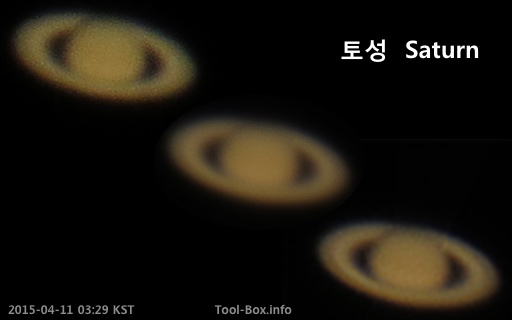
Biggest photos of Saturn from SX50 HS yet
[Raw - Stacked - Wavelet Processed]

Hoping to get a bigger look at the planets, I bought a 5mm LE series eyepiece from e.Frantis. It would supposedly get twice the magnification of the 25mm eyepiece & 2.5x barlow lens combination. After waiting for more than a week for the weather to clear up, I observed the planet Saturn through the brand new eyepiece. It certainly showed the planet nicely, in spite of being a bit dark due to the high magnification.

Not to miss the opportunity to capture this on camera, I got my SX50 HS camera out and placed it over the eyepiece by hand. After several hundred shots, I was able to recover a handful of good photos. Putting them together, I was able to finally have the Cassini Division on the rings of Saturn properly show up. This fulfilled one of the main expectations I had of the Celestron NexStar 6SE telescope.

As for the actual magnification of the eyepiece, my calculations showed that the photos had a 0.22 arc second / pixel resolution, which is about 6.65 times better than the 50x zoom provided by SX50 HS's integrated lens. This is equivalent to having a 8000mm zoom lens. Also, this is 2.4 times the magnification given by the aforementioned eyepiece-barlow lens combo. This is somewhat higher than expected.

Telescope: Celestron NexStar 6SE + 5mm eyepiece
Device: Canon SX50 HS (afocal)
Settings: 24mm - ISO 200 - 1/5s - f/3.4
Filters: None
Time: 2015-04-27 03:16-03:29 KST
Location: Naju, Korea
23 photos stacked with RegiStax 6.1.0.8

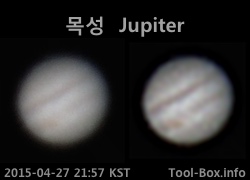
First good Jupiter shots from NexStar 6SE

Getting sharper image of Jupiter from SX50 HS without using integrated zoom

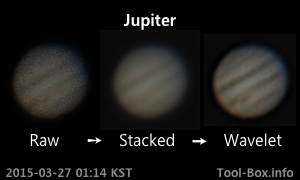
After fixing the collimator screw problem, I spent some time getting my Celestron NexStar 6SE properly collimated. To see if this improved the sights, I pointed the telescope to Jupiter. Sure enough, I could see the details of the clouds on the surface much better. I could even make out the Great Red Spot.

I wanted to capture this on camera, so I attached my Canon EOS 450D DSLR directly to the telescope tube for some prime focus astrophotography. But for reasons I still haven't figured out yet, the photos couldn't resolve any details - the planet was just a yellowish disc. I'd have to take photos of the Moon to see what's going on in the coming days.

Still, I didn't want to waste a good sighting opportunity, so I pulled out my usual astrophotography gear, SX50 HS, and took the photos of Jupiter through the eyepiece and the barlow lens attached to the Celestron NexStar 6SE without using the optical zoom. This yielded a pretty good result, especially considering that I just held the camera up the eyepiece by hand. The disc is also about 2.75 times the diameter compared to what would've been possible with the camera's integrated 50x zoom (0.53 vs. 1.46 arc seconds).

Telescope: Celestron NexStar 6SE + 25mm eyepiece + 2.5x barlow
Device: Canon SX50 HS (afocal)
Settings: 24mm - ISO 80 - 1/80s - f/3.4
Filters: None
Time: 2015-03-27 01:14 KST
Location: Naju, Korea

First Saturn sighting of the year

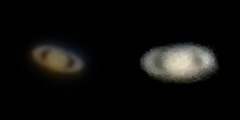
Saturn taken with SX50 HS (left) and iPhone 6 Plus (right)

As Saturn now rises before midnight, it becomes possible to see the planet well above the horizon before it disappears into the morning sky. Seeing that the weather was getting good, I decided to wake up early and see it for myself for the first time this year. I bought a new Celestron NexStar 6SE telescope some time ago and I could use it to pick it out of the southern sky with relative ease.

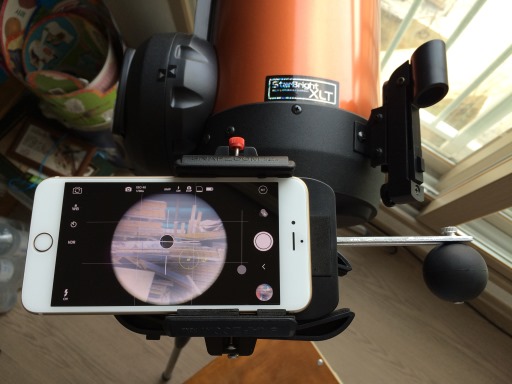
Unfortunately, one of the collimator screws on the telescope is stuck, preventing full calibration. I attached my DSLR to take some photos, but it did not come out well. So instead, I made a couple of quick shots using my iPhone 6 Plus through the eyepiece, which for some reason came out looking slightly better.

Not to waste the opportunity, I then took out my SX50 HS and photographed Saturn as I've done since two years ago. The result was the best the camera has produced so far, I think.

[Left]
Device: Canon SX50 HS
Settings: 1200mm (2x enlarged) - ISO 160 - 1/30s - f/6.5
Filters: None
Time: 2015-03-23 05:35 KST
Location: Naju, Korea
20 photos stacked with RegiStax 6.1.0.8

[Right]
Telescope: Celestron NexStar 6SE + 25mm eyepiece + 2.5x barlow
Device: iPhone 6 Plus (afocal)
Settings: 29mm - ISO 125 - 1/10s - f/2.2
Filters: None
Time: 2015-03-23 06:02 KST
Location: Naju, Korea

Moon and Venus, together

Venus shines on top of the crescent Moon at Bitgaram City

When Venus is visible in the evening sky, a crescent Moon can be found nearby roughly once a month in the west. The clouds and fogs cleared up yesterday evening, and I was able to see the two objects above the unfinished skyline of Naju Bitgaram City. A yellowish layer of smog is seen lingering on the horizon in the photo, but this was gone by the morning.

Device: iPhone 6 Plus
Settings: 29mm - ISO 500 - 1/4s - f/2.2
Filters: None
Time: 2015-03-22 19:29 KST
Location: Naju, Korea
Defined tags for this entry: , , , , , , ,

Comet C/2014 Q2 Lovejoy in the west

Comet C/2014 Q2 Lovejoy is getting dimmer (50% size)

When I last looked at the comet C/2014 Q2 Lovejoy about three weeks ago, it was near its peak apparent brightness due to its proximity - it passed the closest to Earth just 3 days ago and shined at a magnitude of 4. The comet had now moved away, making its closest approach to the Sun two days before this observation. It was still relatively easy to capture it on the camera, as it's only dimmed back to magnitude 5.

The comet had moved to the constellation Andromeda. 59 Andromeda was below the comet, just outside the enlarged photo. The bright star directly above the comet in the enlarged photo is a magnitude 6.6 star called HR677 or HD 14272.

Some issues now complicate its observation other than the slow dimming. From where I observe, the western and northern sky is lit up with light pollution from the center of the city. And these days, constellation Andromeda is in the western sky, already starting to head toward the horizon after sunset. So I have to observe it in the early night, just when the area of the sky is not too brightened one way or another, at around 9 to 10 PM. The dimmest stars in this photo is around magnitude 12, so I think it was a success.

Device: Canon EOS 450D + Tamron 18-270mm Di II VC PZD
Settings: 432mm - ISO 400 - 30s - f/6.3
Filters: None
Time: 2015-02-01 22:29-22:39 KST
Location: Naju, Korea
8 photos stacked with RegiStax 6.1.0.8

Copyright (C) 1996-2025 Woo-Duk Chung (Wesley Woo-Duk Hwang-Chung). All rights reserved.