Saturday, December 8. 2001
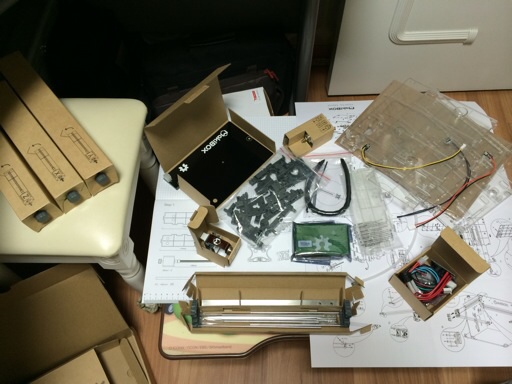
Shortly after returning from the recruitment camp in September, I contemplated on the creation of a computer that could be worn, much akin to wearing a clothing, if possible. This would set the goal of of the resulting system that was both small in length & width, light, and relatively flat. While I found that a modern laptop computers were close to meeting these parameters, I decided not to base my new system on one. First, most modern laptops feature a large display which increased the overall length & width and exceeded my plans. Second, I would want the input and output devices separate from the main unit so that I could use it without having to put the system on a surface somewhere. Third, a laptop computer, even today, is basically a 'ready-made' unit straight from the manufacturer. It does not need work on my side to make it work in the first place. Being a computer freak who's built many custom systems, this is extremely unacceptable. Well, many of the fellow freaks can understand me on this, I'm sure. Now the PDA's came to mind. A today's PDA has full-colour display, has an embedded processor running up to 200MHz, runs Windows-like interface, and has lots of applications that mirror a 'normal' computer's counterpart. They're quite small enough to be 'worn', so to speak, being put into a pocket when not in use. This side of the spectrum sounded good, but was not without shortcomings. Basically, most of the units have very small screens, and running Windows CE or PalmOS, it has reduced functionality compared to a desktop OS. Not to mention I would have to forfeit the use of many of the usual programs I've been accustomed to using. A PDA is a far cry from being a replacement of a true desktop computer. And I've not even mentioned the storage problems. I wouldn't call a PDA a 'computer', so to speak, in these aspects, and therefore was ruled out from selected for use. This pretty much narrowed my choice for building a wearable computer. I need a small motherboard. And a small display. And a small keyboard. And a small pointing device. First things first, I had to find a small motherboard to work my dreams on. This reminded me to search for that myriad of catalogs I had gathered at the trade shows I had visited in the recent years. A single brochure had immediately caught my attention, that of a company called Maxan Systems. This company featured a range of custom-design motherboards built for mainly for set-tops and industrial computers. Naturally, the typical dimensions of the motherboards they made were generally quite smaller than a conventional computer motherboard. I definitely needed to pay this company a visit. Fortunately, this company was native to my country. The office location was a bit elusive, though, and I had to take a long trip by taxi. I found out later that it could be reached easily by a bus (and that which also stops near my dormitory, adding insult to injury), though. I had some lengthy talks about how I need a Maxan motherboard for my project, and how I could browse through the recent products (the catalog I had was apparently old and outdated). The marketing manager showed me the updated catalog so that I could find my motherboard of choice easily. It was deemed that their MSC-740B and MSC-735 models were fulfilling most of my requirements; both were very small, supported Pentium III-level CPU, had 3D capability, and had native LCD panel support. I was sort of leaning on the 735 as it had smaller dimensions, but he explained that the 735 never went into full production and was not a viable choice. Hence my choice was pegged to the 740B. Fortunately, they had some of these models in boxes in the storage room, and I was able to buy the motherboard right on the spot using electronic payment. It was rather expensive, making me $300 poorer, but I felt really good about it.
After completing the world's first portable Athlon computer, it had been on a rather busy public relations charade for a while. It was even featured on SEK 2001, one of the biggest computer shows held in Korea. Here are some pictures.  The Portable Athlon was borrowing a booth of 'I Love PC', a popular monthly magazine in Korea. Some teenage visitors were eagerly watching Portable Athlon running 3DMark2001 demo loop. Many thought that the demo was actually some sort of video clip, testifying the fluidity of the 3D rendering sequence. Clearly, no portable unit at that time had such prowess in 3D performance. This is how the whole booth looked like. You can vaguely see the Lobby part of the demo running on the screen. By the way, the hanging drape on the bottom is saying that 'I Love PC' magazine is the 1st in both published and sold numbers among the computer magazines in Korea. So anyhow, I had thought that my goal of 'carrying a desktop computer anywhere and use it at will' was achieved with this unit. This had, unfortunately, not been completely met with success. First of all, this unit did not have any auxiliary power input, requiring 220V AC input (standard for South Korean power outlet since 80's) if I wish to use it. This isn't exactly a major problem, as, due to the relative size of the unit, it needs to be used on a firm surface like a laptop computer, and the usual places I carry it to does sport a power outlet. Then the actual weight and size became sort of problematic. A unit that goes for nearly 10kg isn't truly fit for easy carrying like a usual mobile gear, not to mention the whole rig was tightly packed in a backpack, making it sort of a hiking trip every time I carry it around. That was okay, I thought, until my health saw a rather rapid decline. I had been hospitalized last August relating to my health conditions. Meanwhile, I had enlisted myself in the army, and I did enter the recruitment camp early September. However, because my medical conditions were ill-fit for military service, I was given a return-home slip within the week. I am listed as 'exempt' regarding military service since late November. This whole mess, while buying me some 26 months of time, left me with lots of concerns. One being that I can no longer do heavy work until my health improves back. My doctor told me that my condition can take forever to get better, so that's apparently not going to happen soon. Let's push my gloomy personal business aside though, as the consequences of the past months simply meant that carrying my Athlon computer around was not as feasible as it once used to be in the scope of this article. This meant I needed to go back to the drawing board for another computer design.
Monday, June 4. 2001
Now it was time for the real test; to hook the air conditioner up to my system and observe temperature differences. System specification is as follows: | CPU: | AMD T-bird 1GHz @ 1.12GHz | | M/B: | Soltek SL-75KAV (KT133A Chipset) | | Heatsink: | Zalman CNPS3100-Gold | | RAM: | 256MB x 1 Corsair PC-150 SDRAM | | Video: | LEOTEC GeForce2 MX 32MB | | HDD: | IBM DeskStar 75GXP 30GB | | OS: | Windows 2000 SP2 | | Else: | Classified ^_^ | Tests were done in a stable ambient temperature environment for 40 minutes and MBM5 was used for temperature detection and logging. CPU was at 100% load during all times of the test using distributed.net client. Providing cold air to the intake fan of the system, the air conditioner should be lowering the system components overall. The result shows that it does indeed do that, as it lowered the CPU temperature by approximately 3C, which correlates to the dry run results. Although not shown here, the GF2 MX's chipset core experienced nearly identical temperature drop also. I believe the project has been a success! I think I can last this summer without much worries now.
The housing was to be made in clear acrylic material like the previous project. To accurately create a housing for the air conditioner, I used a drafting program to create parts and virtually assemble them to see if there were any errors before actual work. My skills at using these programs improved since the last project mostly due to the fact that I'm taking classes about them in the university. Seeing that there weren't any problems to be found, I went back to my home town (Ulsan) to ask for the skilled help of the person who made the case for my Portable Athlon. Without much fiddling, he was able to exactly reproduce my draft into reality. Coincidentally, while this was being made, on the other side of the town, Confederations Cup 2001 preliminaries were being held at newly built Munsu Soccer Stadium. Korea won over Mexico 1-0 that night. The final product meatures 15.0 x 15.5 x 17.0 (cm). This fits in a small totebag, and it is quite possibly yet another 'portable' unit. With everything in order, I set out to find optimal operation point of this unit. Too fast an airflow, the cold side would not be able to put out cold enough air because of insufficient cooling time; too slow and the hot side would overheat. I found out that using 5V for the fan was better than 12V in this sense. Temperature drop against ambient was measured between 2.5C and 3.5C during the tests. Not spectacular, but when a few degrees of drop in temperature matters a lot in overclocking, it certainly didn't look so bad at all.
With key parts now in hand, I could now put them together for some preliminary testing. I was not yet certain if this could actually work, and the lab people did voice some concern about the possible failure, so I needed to see some solid proof. So I put the TEC in between the heatsinks and powered up. The test went rather satisfactorily. The heatsinks distictly heated up or cooled down, and air nearby was affected by it. Unfortunately, it did not have a housing to put them together yet, and it sat around like this for a week.
|