Switching home lighting from FPL to LED
Posted by Wesley on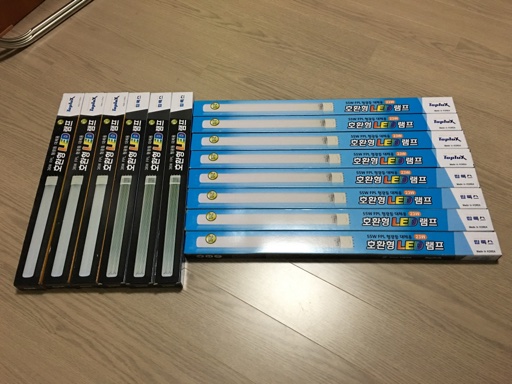
Fluorescent light replacement LED lamps from TopLux - 14 in all
Having a smart meter giving real-time power consumption data provided a lot of insights for my home. The baseline load when everything is idle is about 80W, and the refrigerator running at full power adds 90W to that. So when I noticed that more than 300W were being used during the evening hours even with the TV turned off, I had to track down what the culprit was.
It turned out that the sole reason for this uptick was the lighting. Fluorescent lights in the living room and the study room were turned on for several hours every day and contributing much to the total consumption. Knowing that LED lights were more efficient and that the price has come down a lot recently, I decided to make some major investment.
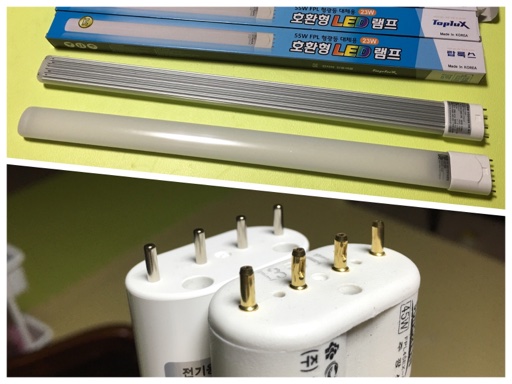
Front and back of the LED lamp / comparison of the connector (back: LED / front: FPL)
As with a lot of apartments in Korea, the typical type of lighting installed was PL compact fluorescent lights, or FPL for short. It uses 4-pin 2G11 socket and has external ballast. Lots of replacement methods exist - lamp-only, ballast + lamp (socket is kept), or total replacement. As the lamp-only method is simplest by far and not much more expensive than replacing everything, the choice was obvious for me. I ordered the relevant LED lamps manufactured and sold by TopLux of Korea which were on sale - 23W version cost about KRW 21,000 (US$17.50) and 15W one, KRW 14,000 (US$11.70). Here is how they stack up with the existing FPL lamps.
| Name | Type | Len. (mm) | Power (W) | Lum.Flux (lm) |
|---|---|---|---|---|
| Hyosun FPL45EX-D | FPL | 540 | 45 | 4060 |
| TopLux FT23-57 | LED | 535 | 23 | 3400 |
| Hyosun FPL32EX-D | FPL | 415 | 32 | 2600 |
| TopLux FT18W-04-57A | LED | 415 | 15 | 2250 |
According to the specifications, the LED lamp consumes about half the power while putting out about 85% of total light, or luminous flux, compared to the similarly sized FPL counterpart. This is indeed quite an increase in efficiency if it delivers. Visually, one side of the lamp is taken up by a long heat sink and uses the same four-pin layout. The pins themselves are simply round, not dimpled in the middle like the FPL it's replacing, so I suppose it won't "hook in" quite as well.